
AI Copilot in Business Central isn’t just “AI”. It’s a new operating model for finance teams
When most people talk about AI Copilot, they focus on productivity gains: faster writing, quicker summaries, fewer clicks.
That narrative misses the real transformation taking place inside Microsoft Dynamics 365 Business Central.
AI Copilot is not just an intelligent assistant layered on top of ERP. Combined with autonomous agents, it introduces a new operating model for finance teams, one built around control, governed automation, and exception-led decision-making.
For CFOs and finance leaders, this distinction is critical.
AI Copilot: moving from “helpful” to genuinely doing the work
Historically, ERP systems have automated transactions but relied on humans to manage decisions and oversight.
AI Copilot changes this model.
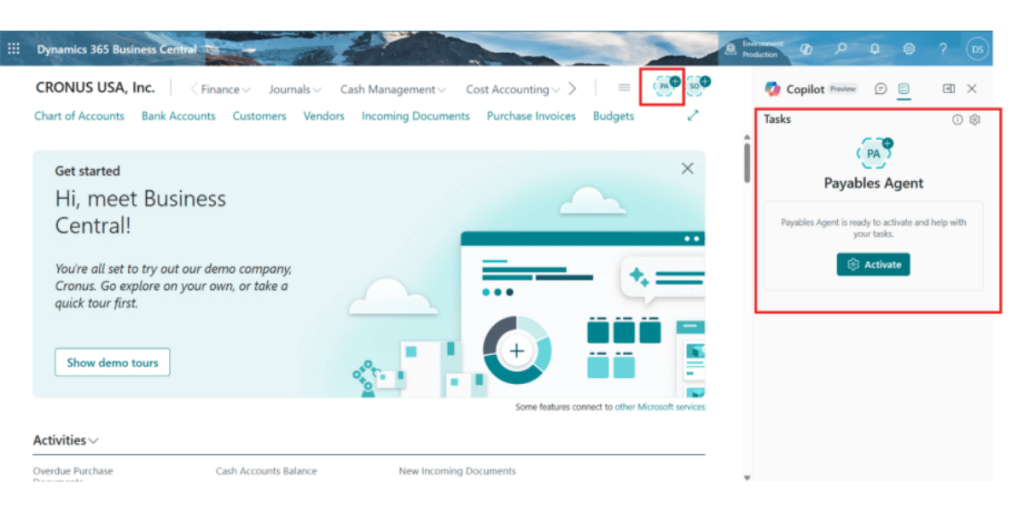
Rather than simply assisting users, Copilot agents inside Business Central can take ownership of defined finance tasks, operate within strict rules, and escalate only when exceptions occur. This moves AI Copilot beyond productivity support into trusted operational execution.
The question finance teams are now asking is no longer:
- “How do we do this faster?”
It is:
- “What work can we safely hand over to AI Copilot without losing control?”
That shift marks a fundamental change in how finance functions scale.
Where finance teams feel AI Copilot first
While AI Copilot touches many areas of Business Central, its most immediate impact is felt in core finance processes where risk, accuracy, and timeliness matter most.
AI Copilot and bank reconciliations
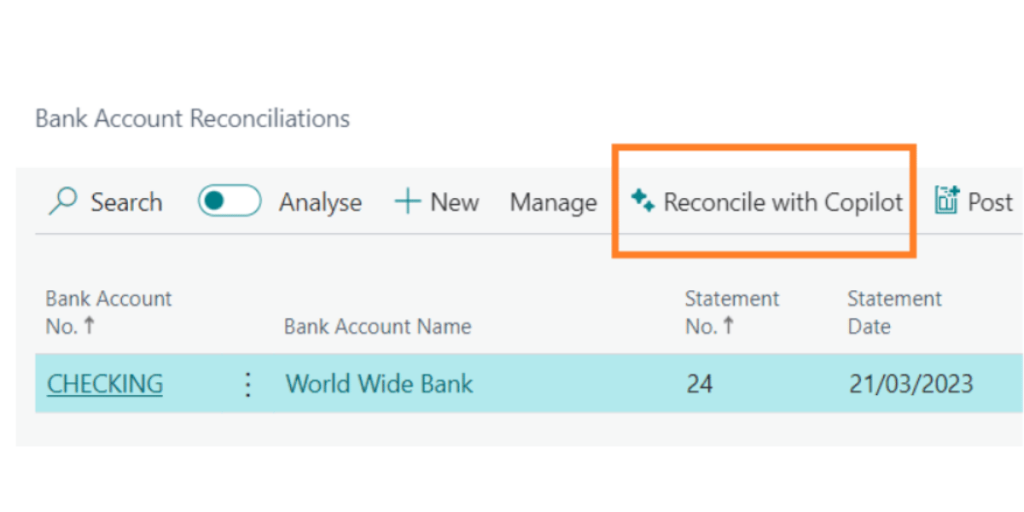
Reconciliations are one of the clearest early wins for AI Copilot in ERP.
Copilot agents can:
- Automatically reconcile known transaction patterns
- Detect anomalies based on predefined tolerances
- Surface only the exceptions requiring human judgement
This approach reduces manual effort while strengthening audit trails and consistency across entities.
AI Copilot for variance analysis
Variance analysis often consumes days at month-end.
With AI Copilot, agents can:
- Compare actuals to budgets and forecasts
- Identify unusual movements
- Provide contextual explanations using historical and transactional data
Instead of building reports and then analysing them, finance teams receive actionable insights first, supported by traceable data.
AI Copilot and faster, safer period close
The monthly close slows down due to small unresolved issues rather than major failures.
AI Copilot helps by:
- Monitoring close readiness in real time
- Prompting approvals before bottlenecks form
- Highlighting unresolved variances early
This does not remove finance oversight. It removes unpredictability.
Why control matters more than productivity with AI Copilot
The real value of AI Copilot in Business Central is not speed.
It is control.
For finance leaders, AI Copilot delivers:
- Stronger approval workflows
- Clear exception management
- Transparent audit trails
- Reduced dependency on manual checking and tribal knowledge
AI Copilot operates within governance frameworks, respecting role permissions, approval hierarchies, and compliance requirements. Every action is logged, reviewable, and explainable.
This is why AI Copilot in ERP should be evaluated as a risk and control enabler, not just a productivity tool.
A practical AI Copilot adoption path for finance teams
Successful AI Copilot adoption is deliberate, not rushed.
A proven approach includes:
- Start with low-risk, high-volume finance processes
Reconciliations, invoice matching, and routine variance checks are ideal starting points for AI Copilot. - Define clear tolerances and escalation rules
AI Copilot should act only within agreed boundaries, escalating exceptions rather than resolving them silently. - Embed governance from day one
Roles, approvals, and auditability must be part of the AI Copilot design, not an afterthought. - Expand as trust grows
As confidence builds, AI Copilot can take on broader operational responsibilities.
This approach enables finance teams to realise value quickly without compromising accuracy or compliance.
AI Copilot across the Microsoft ecosystem — from ERP to productivity.
The future of finance with AI Copilot in Business Central
Microsoft’s roadmap makes one thing clear: AI Copilot and autonomous agents are becoming foundational to how Business Central operates.
For finance teams, this signals a move away from manual oversight of every task towards oversight by exception.
Less time reconciling and chasing.
More time interpreting results and guiding the business.
AI Copilot is not a feature upgrade.
It is a shift in how finance work is structured, governed, and scaled.
And for organisations that adopt it thoughtfully, it will become a long-term operational advantage.